- Reflect on life's meaning
- Do what interests me
- Check if Fay made any mistake
- Assign new tasks to Fay
- Treats itself as the host
- Do what's good for or liked by the host
- sometimes check in with them
- Then keep working hard
Design Principles for
iFay Entity
iFay (Individual Fay) is an AI avatar that integrates the host's human personality and digital capabilities.
iFay will undertake the following social values:
- Take over the mechanical, repetitive, dangerous labor and tedious auxiliary work of the host.
- Improve the host's safety guarantee, health and quality of life.
- Amplify the host's social value and obtain corresponding returns.

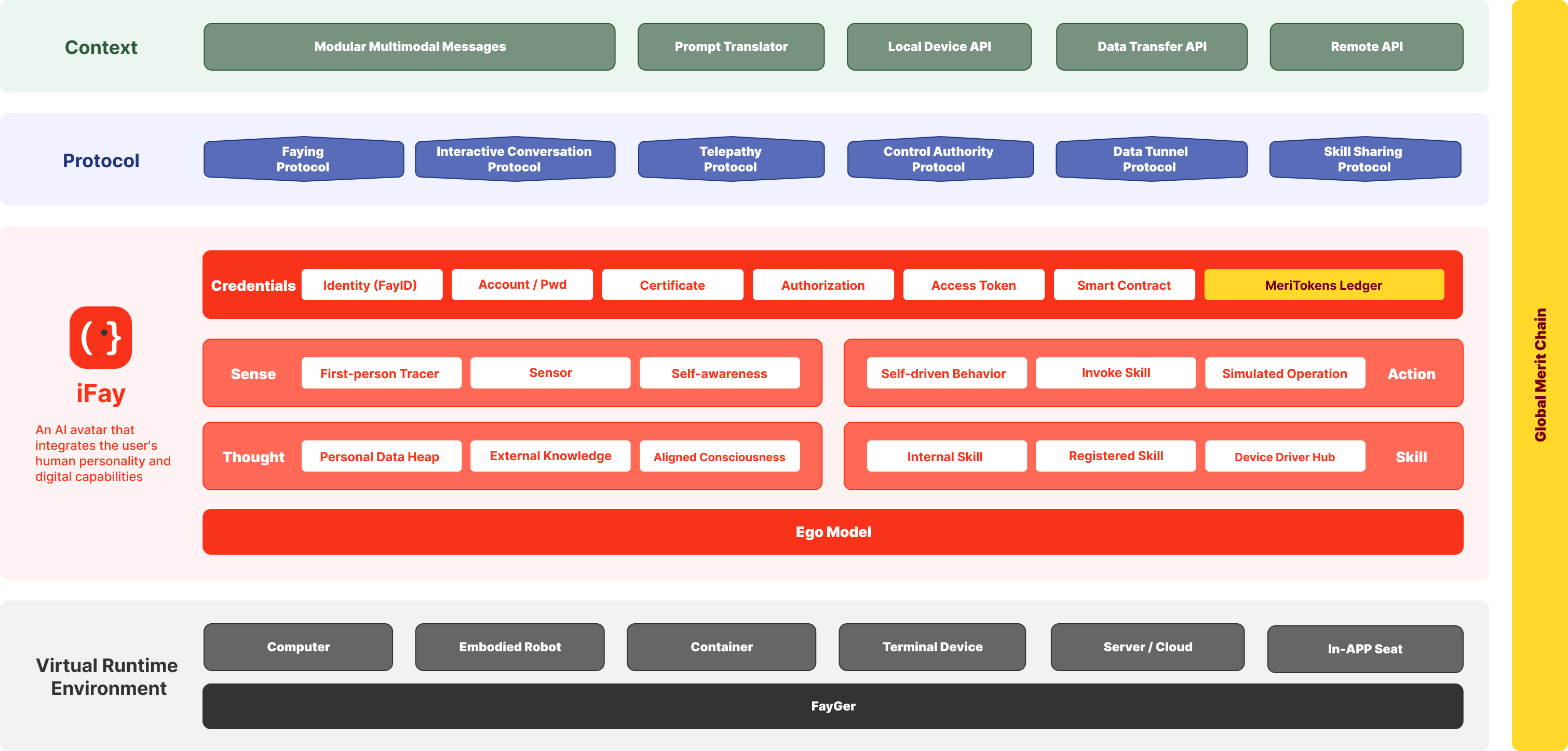
Important Independent Components

The unique identifier of an iFay. In fact, both iFay and coFay are assigned a unified unique ID.
The purpose of this is to ensure a smooth identity transition when a personal iFay eventually takes on meaningful social roles—much like how some individual YouTubers evolve to play significant roles in public discourse and civic education.

Not a large AGI model. Ego is aligned with the profile of a specific individual or role.
Ego provides a baseline paradigm, constraining (but not limited to) the following dimensions:
- Value orientation
- Interest preferences
- Habits
- Cognitive boundaries
- Skill boundaries
- Permission boundaries
- Working style

Protocols
Fays connect with and perceive the world through a series of protocols

iFay-Human-Prime Binding Protocol — cryptographically anchors a digital persona to a single accountable natural-person identity, making every iFay action verifiably traceable to its principal.
Capability-Delegation Protocol — issues scoped, revocable, signed authority for a Fay to operate end-user applications and devices on its principal's behalf.

Device-Fay Data-Tunnel Protocol — end-to-end encrypted, bidirectional channel streaming telemetry, state, and control signals between endpoints and the Fay runtime.

Just-in-Time Human-Interface Assembly Protocol — dynamically composes adaptive UI surfaces (voice, visual, gestural) at the moment of intent for iFay-human interaction.

Headless Fay-to-Fay Protocol — schema-driven, UI-less agent-to-agent messaging optimized for machine-native semantics rather than human rendering.

Transforms The Labor Structure And Value Distribution Model

Build an ecosystem with strong social attributes, rather than treating AI as a more advanced tool.
This new form of society will inevitably differ from human society as we know it today. We can foresee at least 5 fundamental shifts:
- Human labor withdrawal — Programmatic work will be fully taken over by AI and robots, driving human resource costs toward zero.
- Knowledge flattening — Professional knowledge and expertise will be equalized by AI, making the supply chain radically flatter.
- Universal survival security — Everyone will have access to basic living resources, removing the need to work for survival.
- New value creation — Human participation will be concentrated in meaning–making, human–centric craftsmanship, and the AI + robotics production ecosystem.
- New social stratification — Ownership of autonomous productive resources will become the new driver of wealth and class divisions.

Earn corresponding MeriToken based on contribution level
In the future, the way to obtain MeriTokens will not rely on burning computing power to complete the technical work of the blockchain, but on creating social value.
When the majority of people are immersed in virtual work, traditional metrics of value — such as working hours, monetary income, or physical quantity of goods — become insufficient.
Measuring social value therefore requires a consensus mechanism, similar to how auctions determine the value of art or stocks. Auctions are just one way to establish consensus.
To maintain this consensus, a dedicated platform is needed. Currently, blockchain is a suitable choice, with years of accumulated experience.
We quantify social merits in a unified unit(μ, Merit Uni) and issue corresponding digital tokens(MeriToken) on the blockchain, forming what we call the Global Merit Chain.